CaiJing Today is open source — the board, the schema it reads, and the API in between

A market day is a lot of tabs
At 09:25 the call auction ends. At 09:30 the tape starts, and for the next four hours the Chinese market talks continuously — a central-bank operation, a futures point, an index level, a draft regulation, a company filing, an analyst note about the difference between two of them.
All of it is real, and all of it is somewhere. But it is not in the same place.
So you end up with six tabs open — a wire service, a quote page, a sector heatmap, a calendar, a filing index, a forum — and the tab bar quietly becomes the product. Every one of them is a different layout, a different colour scheme, a different idea of what matters, and most of them are built for somebody else's question.
I kept wanting a single board. One page where the hot list, the 7×24 newsflash, sector heat, the economic calendar and the individual-stock hot list are all visible at once, and where every panel answers the same question: what changed, and how much does it matter?
财经今日 (CaiJing Today) is that board. It is Chinese-first, because that is the language the market speaks first, with English one click away.
The board
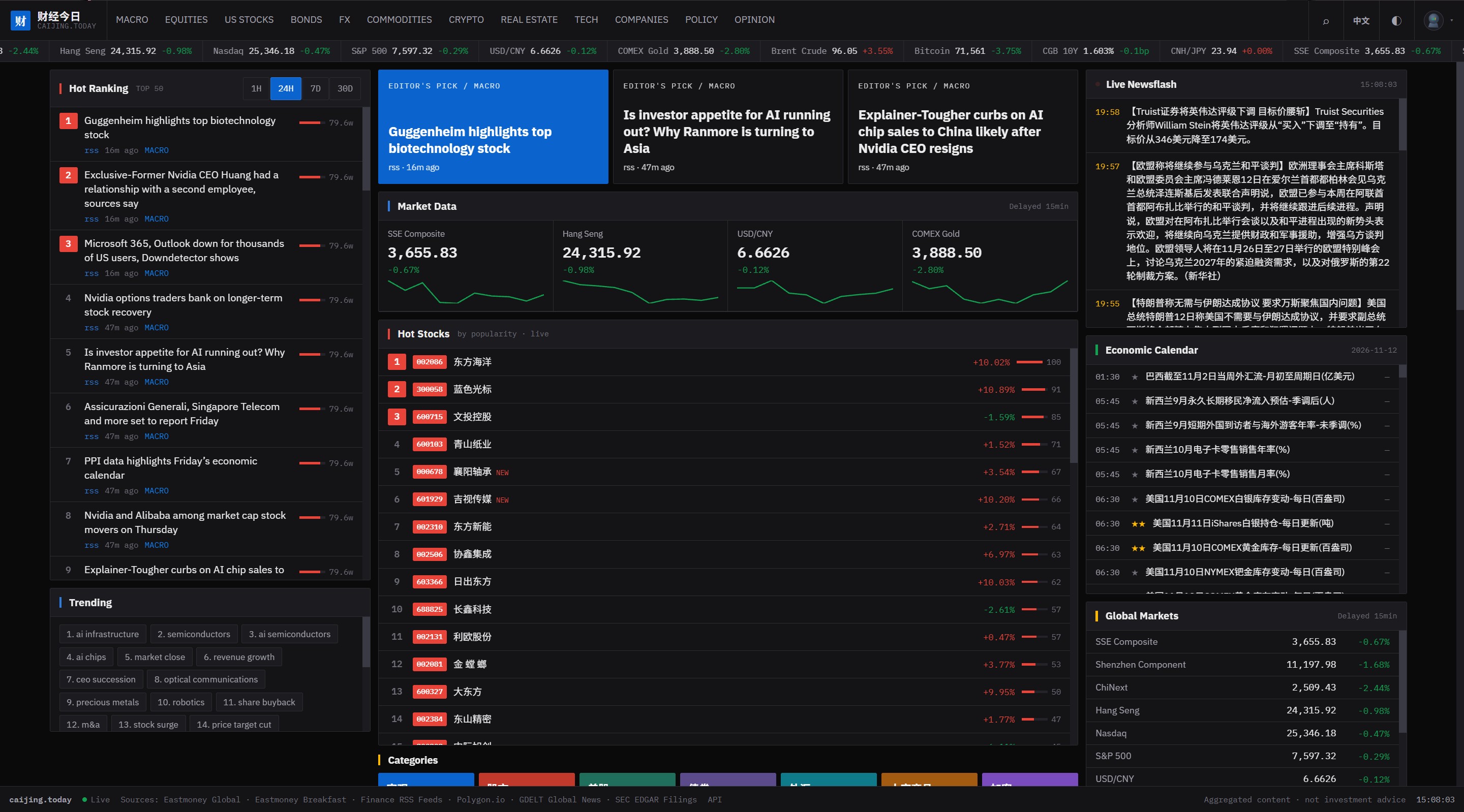
This is the running site — caijing.today — with live data. On the left the TOP 50 hot ranking with its 1-hour / 24-hour / week / month windows and heat bars. In the middle the editorial picks, the market charts and the individual-stock hot list. On the right the 7×24 newsflash, the economic calendar and the global market quotes. The strip across the top scrolls the live quote tape.
Open it and the shape is deliberately dense. A quote strip scrolls along the top. Below that, three columns of panels, each one a window onto the same database, none of them a summary of the others.
- Hot Ranking (热榜 / TOP 50) — headlines ranked by heat, with a window selector. The heat score is not editorial judgement; it is computed from publication time, the confidence of the analysis attached to the item, and how strong its sentiment is.
- Live Newsflash (7×24 快讯) — the newsflash. Short, timestamped, and it keeps its own rhythm while you read, so an article you opened five minutes ago still has the tape beside it.
- Hot Stocks (个股热榜) — the individual-stock hot list, with its own ranking.
- Categories (分类导航) — twelve categories: 宏观, 股市, 美股, 债券, 外汇, 大宗商品, 加密, 房产, 科技, 公司, 政策, 观点. They are not a hand-made taxonomy — each item is classified from its signal type, sectors, region and tags, and you can disagree with the result by hand.
- Economic Calendar (经济日历) — the day's scheduled releases, with an importance rating.
- Market Data / Trending / Global Markets (数据图表 / 热搜关键词 / 全球市场) — the index sparklines, the trending keywords, and the global quote board.
- Sector Heat / Crypto Market (行业板块 / 加密市场) — the sector heatmap with capital inflow, and the crypto board with coins, chains and TVL.
And the whole thing is in two languages, with the toggle in the header. The Chinese is not a translation of the English — the Chinese is the original layout, and English was added beside it.
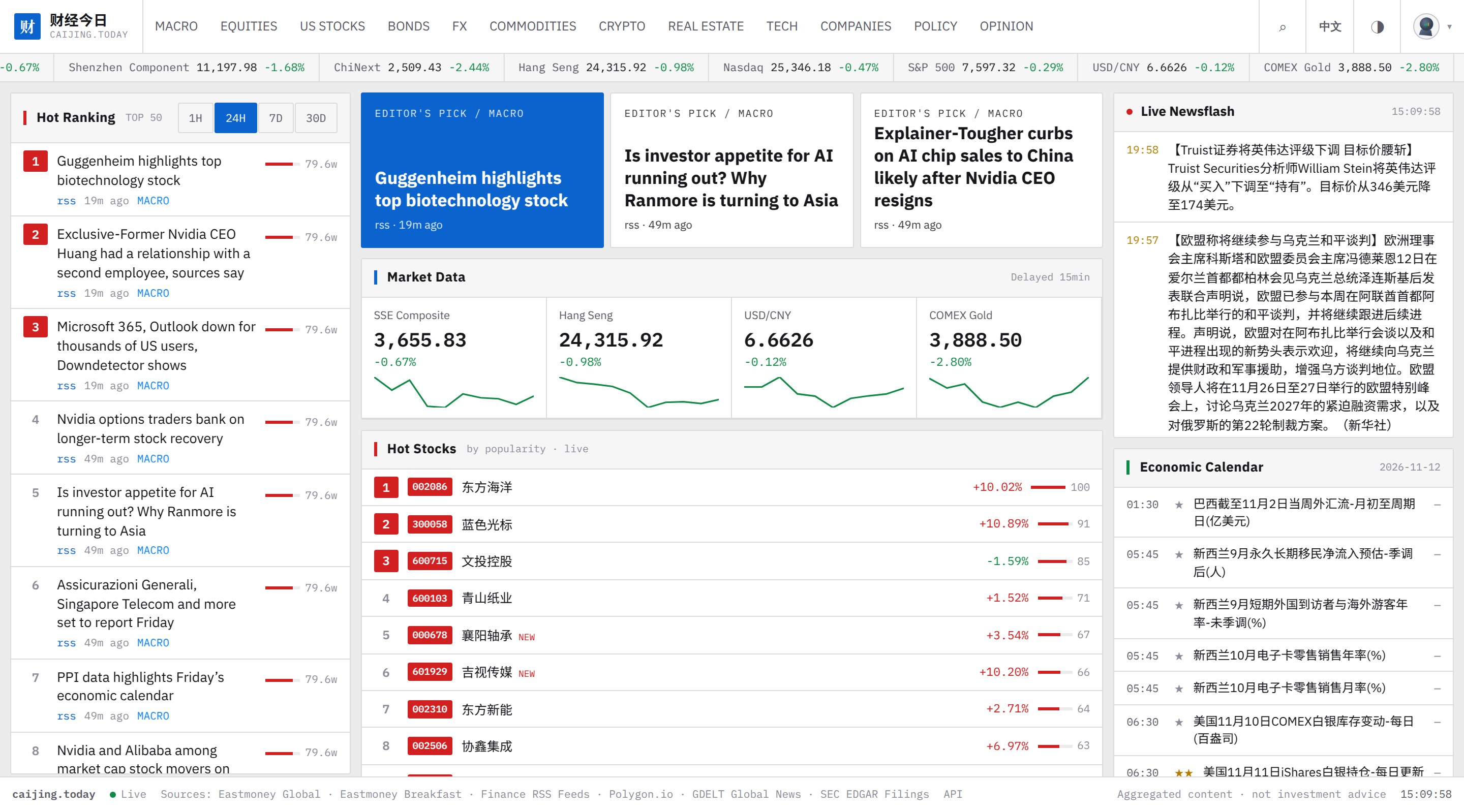
The same board in the light theme. The board is dark by default; the toggle in the header switches it, and the choice is remembered.
The honest technical note
- Frontend — React 19, TypeScript, Vite, TanStack Query, i18next. Strict types, and 55 tests.
- Backend — FastAPI, SQLAlchemy 2 over asyncpg, Pydantic. Read-only: the service never writes to the database it reads.
- Database — PostgreSQL 17. Fifteen tables and two views, published as
docs/SCHEMA.sql. - API — seventeen endpoints under
/api/v1, all of them reads. - Licence — MIT, for the whole repository.
- Tests — 25 backend, 55 frontend, and four CI gates: the backend suite, a schema job that applies the contract to a real PostgreSQL and checks the ORM mirror against it, the frontend suite, and a Docker build of all four images.
This post is not the documentation. The documentation is the repository: the schema contract, the setup guide, the data-source rules and the test matrix. I would rather you read those than take my word for it.
👉 github.com/whereq/CaiJing-Today
To run it:
git clone https://github.com/whereq/CaiJing-Today.git
cd CaiJing-Today

cp docker/.env.example docker/.env
docker compose -f docker/docker-compose.yml up -d --build
Then open http://localhost:8080. That is the whole stack — PostgreSQL 17,
the schema contract, the demo data, the API and the frontend. The API is on
http://localhost:8000, with interactive documentation at /docs.
You do not need any keys to build, test or run it. The defaults in
docker/.env.example are local development credentials, not secrets, and the
site works with no identity provider at all: browsing is public, so the UI
stays in anonymous mode and the sign-in control is hidden.
Why it is in the world now
Because the collector is the part that is not open, and the schema is the part that is.
This repository ships the schema as an explicit contract — 15 tables, two views, the column types, the unique constraints, the snapshot discipline, the UTC rules — and a FastAPI service that reads it and nothing else. The collector that fills those tables in production is a separate component.
I think that split is the useful bit. The schema is not a dump of somebody else's database; it is the agreement between two programs that are allowed to be written by different people. If you want your own collector — your own sources, your own cadence, your own idea of what a headline is — you write a component that inserts into those tables, and the API and the interface serve it with no code changes.
That is the whole extension point, and it is documented in
docs/data-sources.md:
what published_at means, why the snapshot tables take a new as_of instead
of an update, which category ids are legal, and what the heat score is made
of.
One warning, because it matters. The MIT licence covers the code. It says nothing about the data you put into the database. The headlines, quotes and filings a collector retrieves belong to the organisations that published them, each under its own terms, and a financial wire, a free public-data portal and a market-data vendor do not grant the same rights. If you connect real data, complying with those terms is your job, not this project's.
And to be plain about the demo dataset: every row in it is invented. The
headlines are prefixed 【示例】 / [sample], the prices are fabricated, the
calendar entries are placeholders, the links use the reserved .invalid TLD,
and the hot-stock list uses DEMO-001 … DEMO-010 rather than real tickers.
That is deliberate. A real ticker next to a fabricated heat score reads as
investment advice.
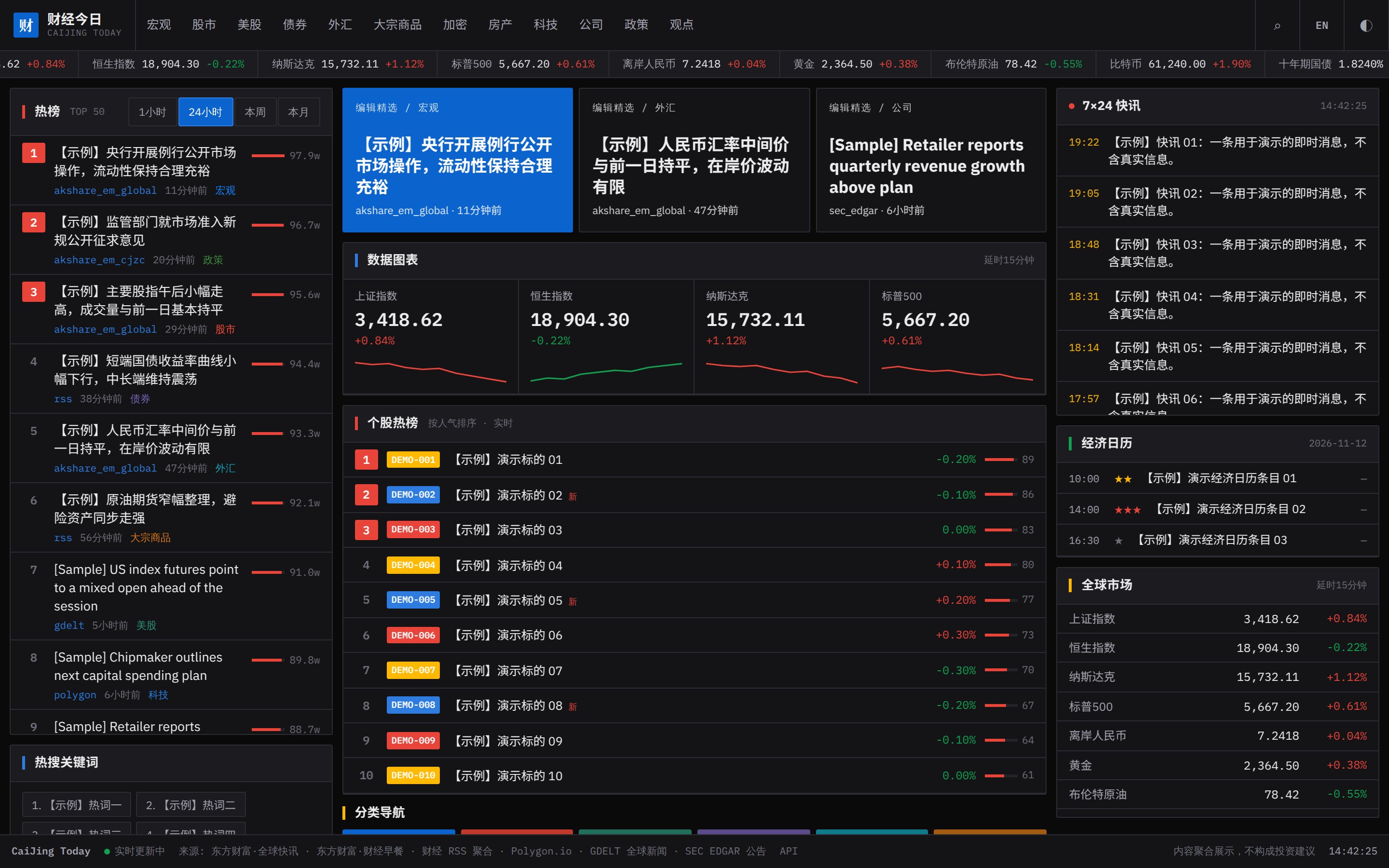
This is what a fresh checkout gives you: the same board, running on the synthetic demo dataset. Every headline is marked 【示例】, every ticker reads DEMO-001 … DEMO-010, and nothing in it is real. The interface is Chinese-first, as it is on the live site.
Credits
This app stands on the work of other people, and it would be dishonest to pretend otherwise.
- Polygon.io — market data. The quote strip, the index levels, the charts.
- GDELT — the global news index behind
the
gdeltsource id. - SEC EDGAR — the US filing index behind
the
sec_edgarsource id. - 东方财富 (Eastmoney) — the 全球快讯 and 财经早餐 feeds the interface
credits as
akshare_em_globalandakshare_em_cjzc. - 财经 RSS 聚合 — the finance RSS feeds behind the
rsssource id. - React, Vite,
TanStack Query,
i18next,
FastAPI,
SQLAlchemy,
Pydantic,
PostgreSQL,
nginx and Docker — the
stack this repository is built on. The dependency list is in
NOTICE.
The demo dataset is also the work of nobody in particular, which is exactly the point: it is synthetic, it says so, and it exists so that a fresh checkout has something to show.
If you write a collector against the schema — or fork the board for a market this one does not cover — I would genuinely like to hear about it.