The SOLID Principles in Software Design and Development
- Introduction
- Single Responsibility Principle (SRP)
- Open/Closed Principle (OCP)
- Liskov Substitution Principle (LSP)
- Interface Segregation Principle (ISP)
- Dependency Inversion Principle (DIP)
- Conclusion
- References:
Introduction
The SOLID principles are a set of five design principles intended to make software designs more understandable, flexible, and maintainable. These principles were introduced by Robert C. Martin (also known as Uncle Bob) and are widely accepted in the software development community. The acronym SOLID stands for:
- Single Responsibility Principle (SRP)
- Open/Closed Principle (OCP)
- Liskov Substitution Principle (LSP)
- Interface Segregation Principle (ISP)
- Dependency Inversion Principle (DIP)
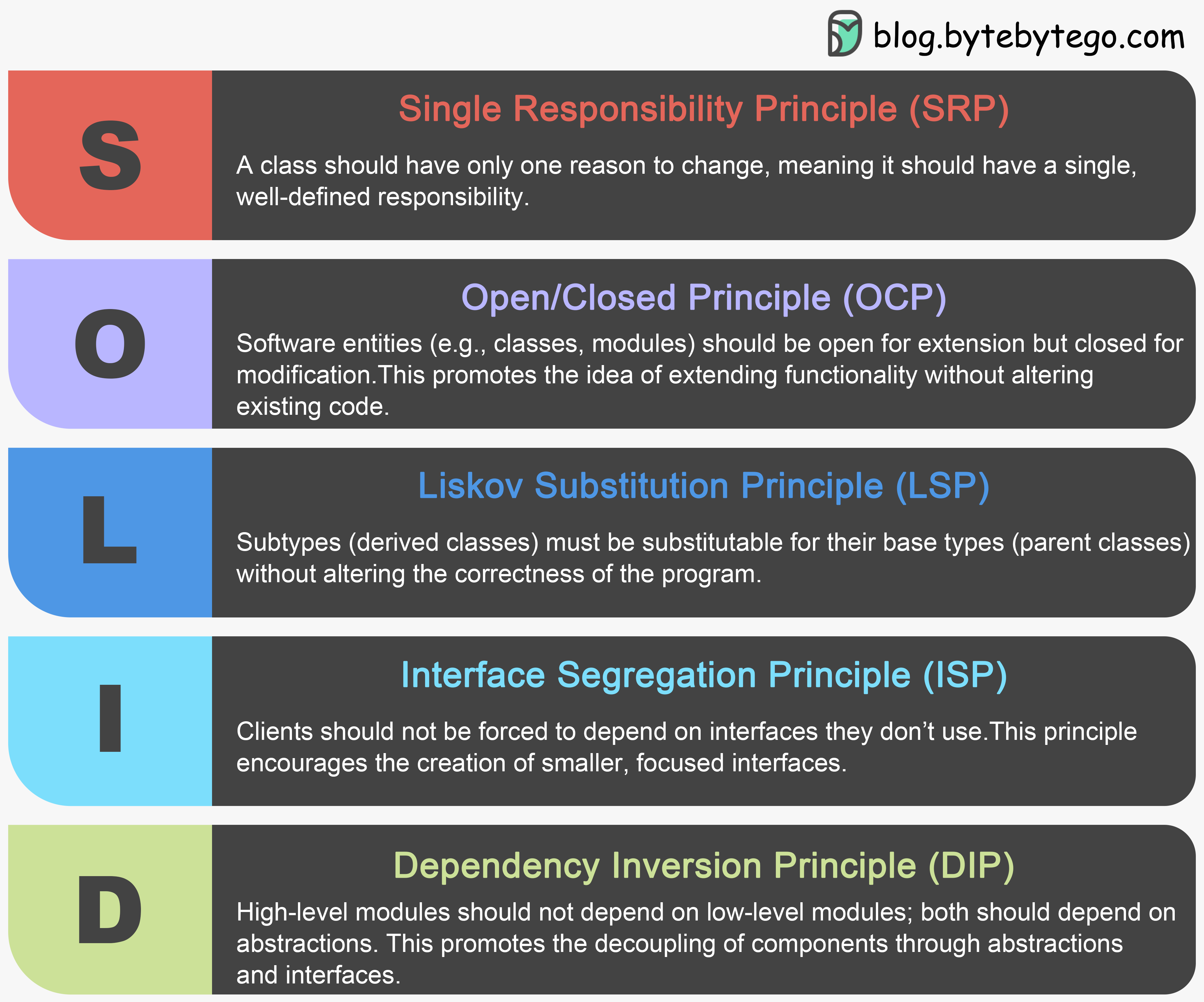 This article will explain each principle, provide examples of how they can be broken, and show the correct implementation to fix them.
Single Responsibility Principle (SRP)
Definition
The Single Responsibility Principle states that a class should have only one reason to change, meaning it should have only one job or responsibility.
Broken Example
class Employee {
    private String name;
    private double salary;

    public Employee(String name, double salary) {
        this.name = name;
        this.salary = salary;
    }

    public void save() {
        // Code to save employee data to the database
        System.out.println("Employee saved to database: " + name);
    }

    public void calculateSalary() {
        // Code to calculate salary
        System.out.println("Salary calculated: " + salary);
    }
}
Correct Example
class Employee {
    private String name;
    private double salary;

    public Employee(String name, double salary) {
        this.name = name;
        this.salary = salary;
    }

    public void calculateSalary() {
        // Code to calculate salary
        System.out.println("Salary calculated: " + salary);
    }
}

class EmployeeRepository {
    public void save(Employee employee) {
        // Code to save employee data to the database
        System.out.println("Employee saved to database: " + employee.getName());
    }
}
Open/Closed Principle (OCP)
Definition
The Open/Closed Principle states that software entities (classes, modules, functions, etc.) should be open for extension but closed for modification.
Broken Example
class Shape {
    String type;

    public Shape(String type) {
        this.type = type;
    }
}

class AreaCalculator {
    public double calculateArea(Shape shape) {
        if (shape.type.equals("circle")) {
            // Calculate area for circle
            return Math.PI * Math.pow(5, 2); // Assuming radius is 5
        } else if (shape.type.equals("rectangle")) {
            // Calculate area for rectangle
            return 10 * 5; // Assuming width is 10 and height is 5
        }
        return 0;
    }
}
Correct Example
interface Shape {
    double calculateArea();
}

class Circle implements Shape {
    private double radius;

    public Circle(double radius) {
        this.radius = radius;
    }

    @Override
    public double calculateArea() {
        return Math.PI * Math.pow(radius, 2);
    }
}

class Rectangle implements Shape {
    private double width;
    private double height;

    public Rectangle(double width, double height) {
        this.width = width;
        this.height = height;
    }

    @Override
    public double calculateArea() {
        return width * height;
    }
}

class AreaCalculator {
    public double calculateArea(Shape shape) {
        return shape.calculateArea();
    }
}
Liskov Substitution Principle (LSP)
Definition
The Liskov Substitution Principle states that objects of a superclass should be replaceable with objects of a subclass without affecting the correctness of the program.
Broken Example
class Bird {
    public void fly() {
        System.out.println("Flying...");
    }
}

class Ostrich extends Bird {
    @Override
    public void fly() {
        throw new UnsupportedOperationException("Ostriches cannot fly");
    }
}
Correct Example
class Bird {
    public void eat() {
        System.out.println("Eating...");
    }
}

class FlyingBird extends Bird {
    public void fly() {
        System.out.println("Flying...");
    }
}

class Ostrich extends Bird {
    // Ostriches do not fly, so no fly method here
}
Interface Segregation Principle (ISP)
Definition
The Interface Segregation Principle states that clients should not be forced to depend on interfaces they do not use.
Broken Example
interface Worker {
    void work();
    void eat();
}

class Robot implements Worker {
    @Override
    public void work() {
        System.out.println("Robot working...");
    }

    @Override
    public void eat() {
        throw new UnsupportedOperationException("Robots do not eat");
    }
}
Correct Example
interface Workable {
    void work();
}

interface Eatable {
    void eat();
}

class Robot implements Workable {
    @Override
    public void work() {
        System.out.println("Robot working...");
    }
}

class Human implements Workable, Eatable {
    @Override
    public void work() {
        System.out.println("Human working...");
    }

    @Override
    public void eat() {
        System.out.println("Human eating...");
    }
}
Dependency Inversion Principle (DIP)
Definition
The Dependency Inversion Principle states that high-level modules should not depend on low-level modules. Both should depend on abstractions. Additionally, abstractions should not depend on details. Details should depend on abstractions.
Broken Example
class LightBulb {
    public void turnOn() {
        System.out.println("LightBulb turned on");
    }

    public void turnOff() {
        System.out.println("LightBulb turned off");
    }
}

class Switch {
    private LightBulb bulb;

    public Switch() {
        this.bulb = new LightBulb();
    }

    public void operate() {
        if (isOn) {
            bulb.turnOff();
            isOn = false;
        } else {
            bulb.turnOn();
            isOn = true;
        }
    }

    private boolean isOn = false;
}
Explanation
In the broken example, the Switch class directly depends on the LightBulb class. This creates a tight coupling between the Switch (high-level module) and the LightBulb (low-level module). Here’s why this violates the Dependency Inversion Principle:
-
Direct Dependency: The
Switchclass directly creates an instance ofLightBulbwithin its constructor. This means that theSwitchclass is tightly coupled to theLightBulbclass. If you want to change the type of device that theSwitchcontrols (e.g., a fan instead of a light bulb), you would need to modify theSwitchclass itself. -
Lack of Abstraction: There is no abstraction layer between the
Switchand theLightBulb. TheSwitchclass is directly aware of the implementation details of theLightBulbclass. This makes theSwitchclass less flexible and harder to extend or modify. -
Rigidity: The
Switchclass is rigid because it can only operate on aLightBulb. If you want to add support for other devices (e.g., aFan), you would need to create a newSwitchclass or modify the existing one, which is not ideal.
Why High-Level Module Depends on Low-Level Module
- Direct Instantiation: The
Switchclass directly instantiates theLightBulbclass within its constructor. This means that theSwitchclass is directly dependent on theLightBulbclass. - No Abstraction Layer: There is no interface or abstract class that both the
SwitchandLightBulbclasses implement. This lack of abstraction means that theSwitchclass is tightly coupled to the specific implementation of theLightBulbclass.
Correct Example
To adhere to the Dependency Inversion Principle, we introduce an abstraction (an interface) that both the Switch and the LightBulb classes depend on.
interface Switchable {
    void turnOn();
    void turnOff();
}

class LightBulb implements Switchable {
    @Override
    public void turnOn() {
        System.out.println("LightBulb turned on");
    }

    @Override
    public void turnOff() {
        System.out.println("LightBulb turned off");
    }
}

class Switch {
    private Switchable device;

    public Switch(Switchable device) {
        this.device = device;
    }

    public void operate() {
        if (isOn) {
            device.turnOff();
            isOn = false;
        } else {
            device.turnOn();
            isOn = true;
        }
    }

    private boolean isOn = false;
}
Explanation of Correct Example
- Abstraction Layer: The
Switchableinterface acts as an abstraction layer. Both theSwitchand theLightBulbclasses depend on this abstraction. - Dependency Injection: The
Switchclass now takes aSwitchableobject as a parameter in its constructor. This allows theSwitchclass to operate on any device that implements theSwitchableinterface, not just aLightBulb. - Flexibility: This design makes the
Switchclass flexible and easier to extend. You can now create other classes that implement theSwitchableinterface (e.g.,Fan) and pass them to theSwitchclass without modifying theSwitchclass itself.
By adhering to the Dependency Inversion Principle, we ensure that high-level modules (like Switch) do not depend on low-level modules (like LightBulb). Instead, both depend on abstractions (like the Switchable interface), making the system more modular, flexible, and easier to maintain.
Conclusion
The SOLID principles are fundamental to writing clean, maintainable, and scalable software. By adhering to these principles, developers can create code that is easier to understand, extend, and refactor. Each principle addresses a specific aspect of software design, and understanding how to apply them correctly can significantly improve the quality of your code.
References:
https://blog.bytebytego.com/p/mastering-design-principles-solid